





GBP/EUR exchange rate bolstered by BoE April policy announcement
Following a subdued start to the month, the pound briefly jumped above 1.15 against the euro on 8 April amid a risk-on market mood and a decline in UK government bond yields, easing economic concerns. Meanwhile, the single currency weakened following the release of disappointing German factory orders data and a contraction in Eurozone retail sales. This was compounded by the announcement of a US-Iran ceasefire, which reduced both energy prices and investor expectations for a rate hike by the European Central Bank (ECB).
The pound strengthened to within touching distance of 1.15 on 13 April, bolstered by a proposed arrangement that would allow the UK to adopt new EU rules without a full parliamentary vote. This potential for closer alignment between the UK and the EU’s single market raised investor hopes for easing trade friction with the bloc.
The pound edged above the 1.15 benchmark the following day, even as forecasts for UK economic growth were revised notably lower. According to the International Monetary Fund (IMF), the UK will be the most affected G7 economy by the US-Iran conflict, with growth dropping to 0.8% from the earlier estimate of 1.3%. The euro softened under pressure from risk-on conditions and dovish remarks from ECB President Christine Lagarde.
Despite official data showing the UK posted stronger-than-expected economic growth in February, the pound softened against the euro on 16 April. The GDP print revealed a 0.5% expansion, exceeding forecasts, but did not reduce BoE rate hike expectations.
The pound rose against the euro on 21 April following the release of a mixed UK jobs report, with falling unemployment undermined by signs of a weak labour market. Meanwhile, the euro was dented by a disappointing German economic sentiment index for April.
The pound rose above the 1.15 level the following day after weaker-than-expected Eurozone consumer sentiment in April generated euro headwinds. The UK’s consumer price index for March had little impact on expectations for BoE interest rate hikes. Headline inflation increased from 3% to 3.3%, in line with forecasts, while core inflation edged down from 3.2% to 3.1%.
The pound rose to three-week highs above 1.1540 on 23 April, supported by stronger-than-forecast UK PMI figures that indicated private sector activity strengthened in April despite disruption in the Middle East. The euro was undermined by the Eurozone’s latest PMIs, which revealed a steeper-than-expected contraction in private sector output, raising concerns about the ECB’s ability to implement a rate hike.
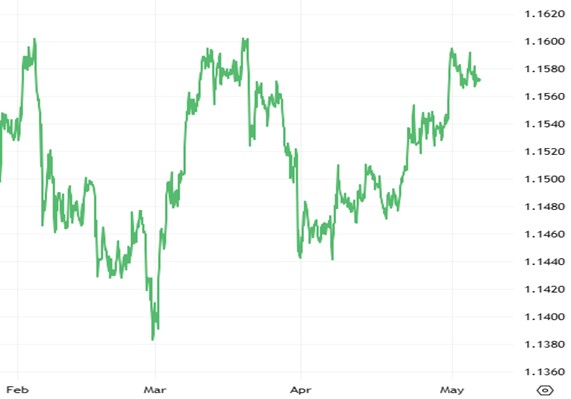
Following a period of relative calm, policy announcements from both sides caused the pound to jump nearly half a per cent on 30 April to within touching distance of the 1.16 benchmark – touching its highest level in five weeks. Although the BoE left interest rates unchanged, the central bank indicated that persistent inflationary pressures could necessitate tighter policy this year. Euro sentiment remained fragile after the ECB voted to keep interest rates on hold. The single currency faced further pressure after Eurozone’s latest GDP print revealed an unexpected contraction in first-quarter growth.
The pound euro exchange rate ended the month around 1.159.
GBPEUR: 3-Month Chart
Looking Ahead
Influential data from the UK economy in May: Claimant Count Change (14 May), Employment Change (14 May), ILO Unemployment Rate (14 May), GDP (14 May), Consumer Price Index (20 May), S&P Global Composite PMI (21 May), Retail Sales (22 May).