





GBP/USD exchange rate hit two-month high in April
The pound rose sharply against the dollar on 7 April after the US currency plunged on US-Iran ceasefire optimism.
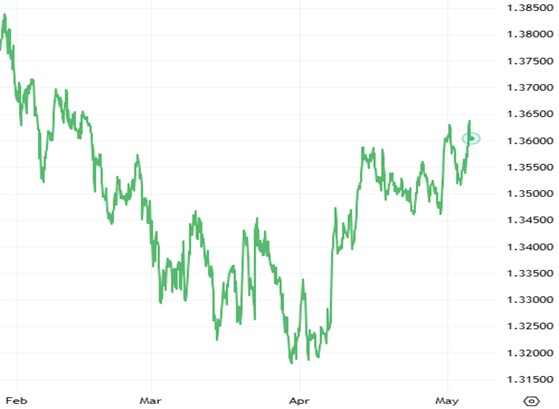
The pair peaked in the 1.34 mid-range the following day as the increasingly risk-sensitive pound advanced against safe-haven currencies following news of the US-Iran ceasefire. This reignited expectations that the Federal Reserve may lower interest rates later this year.
The pound broke through the 1.35 resistance level against the dollar on 13 April, touching a six-week high. Plans under consideration, allowing closer alignment between the UK and the EU’s single market, provided the UK currency with impetus to move higher.
The pound maintained its upward momentum the following day, falling just shy of 1.36, despite forecasts for UK economic growth in 2026 being sharply revised lower to 0.8% – down from a previous estimate of 1.3%.According to the International Monetary Fund (IMF), the UK is on course to be the hardest-hit G7 economy by the conflict in Iran. Meanwhile, the safe-haven dollar was severely undermined by remarks from US President Donald Trump, who suggested that peace negotiations could resume within days.
Data showing stronger-than-expected UK economic growth in February caused the pound to slip against the dollar on 16 April. Although the GDP print revealed a 0.5% expansion, above forecasts, it failed to offset a reduction in expectations for Bank of England (BoE) interest rate hikes.
The pound traded in a narrow range versus the dollar between 20 and 24 April amid conflicting signals on peace talks, a mixed UK labour report and a muted CPI. Headline UK inflation rose from 3% to 3.3% in March, in line with forecasts, while core inflation ticked down from 3.2% to 3.1%. The print failed to meaningfully impact expectations for BoE rate hikes this year.
The US Federal Reserve’s latest monetary policy decision supported the dollar on 29 April, as policymakers left interest rates unchanged but revealed signs of a hawkish split within the Federal Open Market Committee.
The pound jumped more than 1.5% against the dollar on 30 April following the BoE’s latest policy decision – a sharp move higher that edged it above the 1.36 benchmark for the first time since mid-February. Although the central bank voted to leave interest rates unchanged, it indicated that persistent inflationary pressures could necessitate tighter policy in the future.
The pound dollar exchange rate ended the month around 1.360.
GBPUSD: 3-Month Chart
Looking Ahead
Influential data from the UK economy in May: Claimant Count Change (14 May), Employment Change (14 May), ILO Unemployment Rate (14 May), GDP (14 May), Consumer Price Index (20 May), S&P Global Composite PMI (21 May), Retail Sales (22 May).
Influential data from the US economy in May: ISM Manufacturing PMI (1 May), ISM Services PMI (5 May), ADP Employment Change (6 May), Nonfarm Payrolls (8 May), Average Hourly Earnings (8 May), Consumer Price Index (12 May), Producer Price Index ex Food & Energy (13 May), Retail Sales (15 May), Michigan Consumer Sentiment Index (15 May), S&P Global Manufacturing PMI (21 May), S&P Global Services PMI (21 May), Core Personal Consumption Expenditures – Price Index (21 May).